10 Breakthroughs in Mars Rotor Technology Beyond Ingenuity
In January 2024, NASA's Ingenuity helicopter ended its historic Mars mission after 72 flights, proving that powered flight is possible on another world. Now, engineers at the Jet Propulsion Laboratory (JPL) are building on that success with next-generation rotorcraft that can carry heavier payloads over greater distances through the thin Martian atmosphere. This listicle explores the key developments and future missions, including the planned SkyFall mission and its nuclear-powered spacecraft, SR-1.
1. The Legacy of Ingenuity: A Pioneering First Flight
Ingenuity was a technology demonstration that exceeded all expectations. Designed for just five flights over 30 days, it made 72 flights and traveled over 11 miles. Its crash-landing in January 2024 ended its mission but not its impact. The helicopter showed that aerial exploration could reach areas inaccessible to rovers, like steep cliffs and craters. This success laid the groundwork for more advanced rotorcraft, proving that the low-density Martian atmosphere (about 1% of Earth's) can support flight with the right design.
2. The Challenge of Mars' Thin Atmosphere
Mars' atmosphere is extremely thin, with a surface pressure less than 1% of Earth's. To achieve lift, rotor blades must spin at high speeds—Ingenuity's blades rotated at over 2,400 rpm. For heavier payloads, engineers need even faster rotation or larger blades. JPL's breakthrough involves new rotor designs that are stronger and lighter, using advanced composites and aerodynamics. These rotors can generate enough lift to carry instruments, cameras, and even small sample return containers.
3. Breakthrough in Rotor Technology at JPL
JPL engineers have developed a novel rotor blade shape and material that significantly increases lift efficiency. By combining carbon fiber with a unique airfoil profile, the new rotors can operate at lower speeds while still lifting more mass. This breakthrough allows the next generation of Mars helicopters to carry up to 5 kilograms of payload—compared to Ingenuity's 1.8 kilograms. The design also reduces wear and tear, enabling longer missions over rugged terrain.
4. Next-Generation Rotorcraft: Bigger, Stronger, Smarter
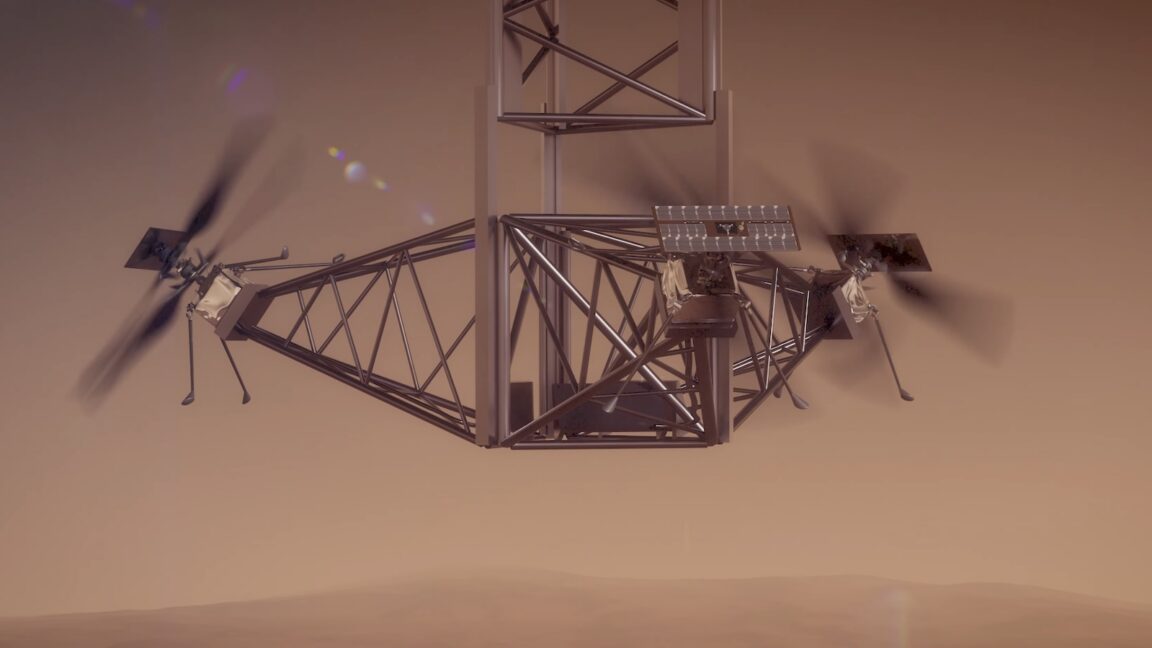
The new rotorcraft will be larger than Ingenuity, with a diameter of about 4 feet versus 4 feet for Ingenuity. They will feature autonomous navigation systems that use stereo cameras and LiDAR to map the terrain in real-time. This allows them to land safely and avoid obstacles. The craft will also have solar panels for recharging, extending their operational life. They are designed to fly up to 2 miles per flight, covering more ground than any rover.
5. The SkyFall Mission: Three Helicopters to Mars
NASA's SkyFall mission, targeted for launch as early as late 2028, will send three of these next-generation helicopters to Mars. Each helicopter will be deployed from a central lander, similar to how Perseverance deployed Ingenuity. The helicopters will work together to explore a region known for its geological diversity. They will be able to relay data back to Earth via the lander, providing high-resolution images and atmospheric measurements.
6. Space Reactor-1 (SR-1): Nuclear Power for Deep Space
SkyFall will be carried to Mars aboard a nuclear-powered spacecraft called Space Reactor-1 (SR-1). This is one of the tech demo initiatives announced by NASA Administrator Jared Isaacman. SR-1 uses a compact nuclear fission reactor to generate electricity, providing far more power than solar panels alone. This enables faster transit to Mars and allows for more power-hungry instruments on the helicopters. It also paves the way for future crewed missions, where nuclear propulsion will be essential.
7. Comparing SkyFall Helicopters to Ingenuity
While Ingenuity was a proof-of-concept, SkyFall's helicopters are built for science. They have larger batteries, more efficient rotors, and advanced avionics. Each can carry a payload of up to 5 kg, including a spectrometer and a multispectral camera. They are also designed to fly in coordination, covering a wider area. Unlike Ingenuity, which relied on Perseverance for communication, the SkyFall helicopters will communicate directly with a dedicated orbiter or lander.
8. Potential Scientific Discoveries
With the ability to traverse up to 2 miles per flight and access vertical cliffs, these helicopters can investigate places rovers cannot reach. They can search for signs of ancient water ice, study mineral deposits, and monitor weather patterns. Their cameras will provide images with resolution down to a few centimeters per pixel, crucial for identifying potential landing sites for future human missions. Scientists hope to find evidence of past microbial life in areas that were once wet.
9. Engineering Challenges and Solutions
Developing rotors for Mars is extremely challenging. The thin air requires precise engineering to avoid blade stall. JPL solved this by using a twisted blade design that optimizes lift across the span. The rotors also had to withstand frigid temperatures (down to -120°C) and wind gusts up to 30 mph. New materials like shape-memory alloys help the blades adjust to conditions. These technological advances have applications beyond Mars, such as high-altitude drones on Earth.
10. The Future of Aerial Exploration Beyond Mars
SkyFall is just the beginning. The success of Ingenuity and the upcoming helicopters will lead to even more ambitious missions. NASA is studying concepts for a Mars Science Helicopter that could carry up to 10 kg and fly for dozens of miles. Similar designs could be adapted for Titan, Saturn's moon with a thick atmosphere, or Venus's upper atmosphere. The breakthroughs in rotor technology from JPL will power exploration across the solar system.
The journey from Ingenuity's first 39-second flight to a fleet of nuclear-powered helicopters shows how quickly technology can evolve. With SkyFall and SR-1, NASA is pushing the boundaries of what's possible on Mars. These next-generation rotorcraft will unlock secrets of the red planet and inspire the next wave of space exploration. The lessons learned at JPL will echo for decades, turning science fiction into fact.