Navigating Away from Sea of Nodes: V8's Move to Turboshaft
For over a decade, V8's optimizing compiler Turbofan relied on the innovative Sea of Nodes (SoN) intermediate representation (IR). However, recognizing the growing complexity and limitations of SoN, the team began transitioning to a more traditional Control-Flow Graph (CFG) based IR called Turboshaft. This shift, ongoing for nearly three years, aims to streamline compilation, reduce technical debt, and improve performance predictability. Below, we explore the key questions surrounding this significant architectural change.
What led V8 to move away from the Sea of Nodes intermediate representation?
The move away from Sea of Nodes (SoN) was driven by several factors accumulated over Turbofan's lifetime. SoN's complexity made it difficult to maintain and extend, especially when adding new features or supporting new architectures. The IR's lack of explicit control flow hindered optimizations like lowering high-level operations, which often require introducing control flow (e.g., for type-dependent paths). Additionally, SoN contributed to performance cliffs and deoptimization loops, frustrating developers. The team concluded that a more straightforward CFG-based IR would simplify the compiler, reduce bugs, and enable faster development. Turboshaft emerged as the solution, offering a cleaner separation of concerns between operations and control flow, while retaining the optimization power needed for modern JavaScript and WebAssembly.
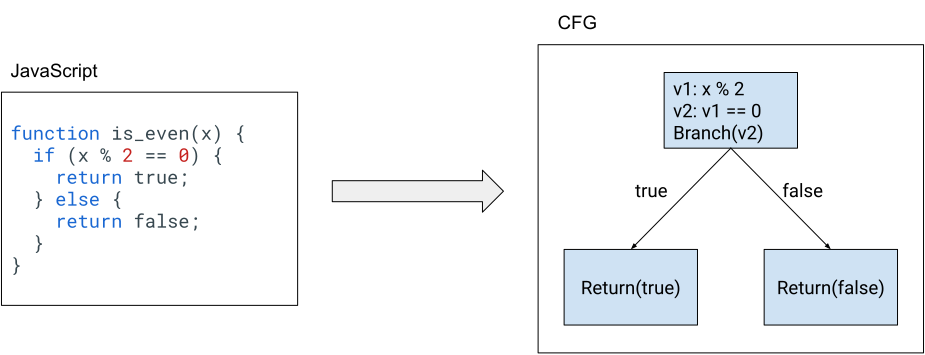
What is Turboshaft and how does it differ from Sea of Nodes?
Turboshaft is a new Control-Flow Graph (CFG) intermediate representation designed to replace Turbofan's Sea of Nodes. Unlike SoN, which represents the program as a single graph without explicit control flow edges, Turboshaft uses a more traditional approach with basic blocks and explicit control flow transitions. This simplifies graph construction and manipulation. For example, lowering a complex operation like JSAdd can introduce conditional blocks directly in the CFG, something that required cumbersome workarounds in SoN. Turboshaft also reduces the number of IR nodes and edges, making it easier to debug and optimize. The design emphasizes modularity, allowing each compiler pass to operate on a cleaner representation. While SoN is powerful for certain analyses, Turboshaft's simplicity and flexibility make it a better fit for V8's evolving needs.
What were the major issues with Crankshaft that prompted a rewrite?
V8's earlier compiler, Crankshaft, suffered from several critical problems that led to the creation of Turbofan. First, it relied heavily on manual assembly code for each supported architecture (x64, IA-32, ARM, ARM64), making adding new operators slow and error-prone. Second, it struggled with optimising asm.js, a key use case for high-performance JavaScript. Third, Crankshaft fixed control flow at graph-building time, preventing low-level optimisations that introduce new branches. This made it impossible, for instance, to lower JSAdd(x, y) into a type-check plus specialised addition. Fourth, try-catch support was extremely difficult to implement, with engineers spending months without success. Fifth, performance cliffs and bailouts were common—using a feature could cause 100x slowdowns. Sixth, deoptimization loops occurred when Crankshaft repeatedly reoptimised with the same speculative assumptions. These issues made Crankshaft unsuitable for modern JavaScript demands, necessitating a new compiler.
How does Turboshaft address the limitations of Crankshaft?
Turboshaft directly tackles many of Crankshaft's shortcomings. Its CFG-based IR allows dynamic control flow insertion during lowering, enabling optimisations like type-specific code paths without requiring pre-built branches. This eliminates Crankshaft's fixed control flow limitation. Turboshaft also reduces manual assembly by using a backend that automatically maps operations to target instructions, supporting multiple architectures from a single description. The new IR simplifies try-catch support by explicitly modelling exceptional control flow. Performance cliffs are minimised because Turboshaft avoids the subtle interactions between graph nodes that caused bottlenecks in SoN. Furthermore, deoptimization loops are reduced through improved speculative optimisation validation and better integration with profiling data. Together, these improvements make Turboshaft more maintainable, predictable, and performant for both JavaScript and WebAssembly compilation.
What is the current status of Sea of Nodes usage in V8?
As of this writing, the JavaScript backend of Turbofan has fully transitioned to Turboshaft. The WebAssembly pipeline also uses Turboshaft throughout. However, two parts of Turbofan still retain Sea of Nodes: the builtin pipeline (being slowly replaced) and the frontend of the JavaScript pipeline (which Maglev, another CFG-based IR, is replacing). This phased migration ensures stability while gradually retiring the older code. The team plans to complete the transition to eliminate SoN entirely, leaving only Turboshaft and Maglev as the primary IRs for V8's optimising compilers. This shift represents a significant engineering effort but is expected to yield long-term benefits in compiler maintainability and generated code quality.
What are the performance implications of switching to Turboshaft?
Initial benchmarks indicate that Turboshaft maintains competitive performance with Sea of Nodes while eliminating many pathological cases. The new IR reduces compilation time due to simpler graph structures and fewer node types. Runtime performance is generally on par, with improvements in scenarios that previously triggered performance cliffs or deoptimization loops. For WebAssembly, Turboshaft enables better code generation by allowing more aggressive inlining and instruction selection. Developers should see fewer unpredictable slowdowns and more consistent optimisation results. The team continues to refine Turboshaft, so further gains are expected. Overall, the transition aims to provide a more stable and predictable performance profile, making it easier for developers to reason about JavaScript and WebAssembly performance.
How does Turboshaft improve WebAssembly compilation?
Turboshaft brings specific advantages to WebAssembly (Wasm) compilation within V8. Its CFG-based IR maps naturally to Wasm's structured control flow, reducing overhead during translation. The ability to introduce control flow during lowering allows Turboshaft to optimise Wasm operations like memory accesses and function calls more efficiently. Since Wasm often requires fast, predictable code, Turboshaft's reduced complexity minimises compilation time without sacrificing optimisation quality. Additionally, Turboshaft supports multi-architecture backends seamlessly, which is crucial for Wasm's cross-platform deployment. The move to Turboshaft has enabled the Wasm pipeline to be fully unified, eliminating the hybrid approach that previously mixed SoN and CFG. This streamlines development and maintenance, ensuring that Wasm benefits from the same optimisations as JavaScript, ultimately leading to faster and more reliable WebAssembly execution.