NASA's Next-Generation Mars Helicopters: Building on Ingenuity's Legacy
Introduction: A New Chapter in Martian Flight
Just over three years after NASA's Ingenuity helicopter completed its historic mission on Mars with a crash landing in January 2024, engineers at the Jet Propulsion Laboratory (JPL) in California are pushing the boundaries of rotor technology. Their goal: to create next-generation rotorcraft capable of carrying heavier scientific payloads over longer distances through the Red Planet's extremely thin atmosphere. Ingenuity's unexpected success—72 flights instead of the planned five—has proven that aerial exploration on Mars is not only possible but transformative.
The Challenge of Mars' Thin Atmosphere
Mars' atmosphere is only about 1% as dense as Earth's, making lift generation a monumental challenge. Conventional helicopter blades would struggle to generate enough upward force. Ingenuity overcame this by using ultra-light composite blades spinning at a blistering 2,400 revolutions per minute—roughly five times faster than a terrestrial helicopter. The new designs at JPL aim to improve upon this by optimizing blade shape, materials, and rotational speed to handle even heavier payloads, such as advanced spectrometers and sample collection tools.
Blade and Rotor Innovations
JPL engineers are experimenting with longer, more aerodynamically efficient blades that can operate at lower RPMs while still generating enough lift. These blades incorporate advanced carbon-fiber composites and perhaps even morphing surfaces that adjust to changing aerodynamic conditions. The goal is to increase payload capacity from Ingenuity's few pounds to potentially tens of pounds, enabling more complex science missions.
Power and Propulsion Overhauls
Ingenuity relied on solar panels for energy. Future rotorcraft could use more powerful batteries or even small nuclear-thermal generators to enable longer flights and night operations. Engineers are also testing hybrid propulsion systems that combine electric rotors with small chemical thrusters for short bursts of extra lift in turbulent conditions.
SkyFall Mission: Three Helicopters to Mars
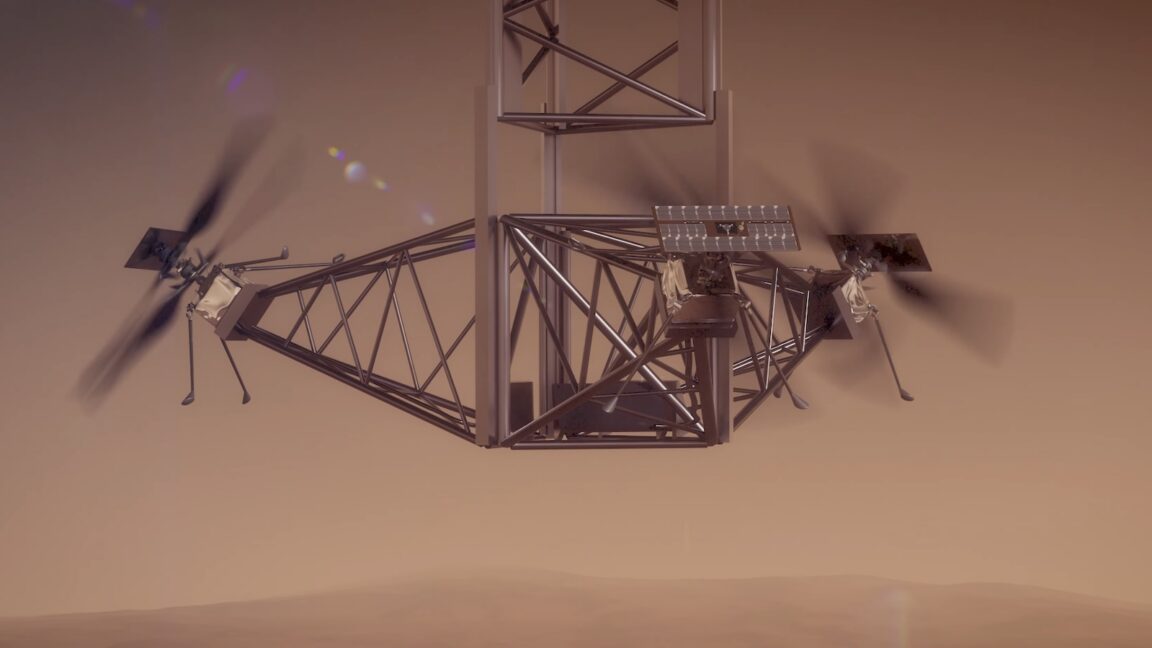
NASA's ambitious SkyFall mission, which could launch as early as late 2028, plans to send three advanced helicopters to Mars. These rotorcraft will be significantly larger than Ingenuity, each roughly the size of a small drone with a payload bay capable of housing scientific instruments. SkyFall's primary objective is to demonstrate that multiple rotorcraft can work in tandem, covering vast areas and providing unprecedented mobility for exploration.
Nuclear-Powered Ride: Space Reactor-1 (SR-1)
The SkyFall mission will hitch a ride aboard Space Reactor-1 (SR-1), a nuclear-powered spacecraft announced earlier this year by NASA Administrator Jared Isaacman. SR-1 is part of a tech demo program to test compact nuclear reactors for deep-space propulsion. This would cut travel time to Mars from about seven months to just four, reducing exposure to cosmic radiation for sensitive electronics and biological payloads (if any). The nuclear power source also provides abundant electricity for the helicopters once on Mars, allowing them to recharge quickly and operate even during dust storms.
Expanding the Horizons of Planetary Exploration
The Ingenuity mission opened a new chapter in planetary science by proving that aerial mobility is viable on another world. Its 72 flights covered nearly 11 miles, captured hundreds of high-resolution images, and scouted terrain inaccessible to the Perseverance rover. The next generation aims to build on this legacy by enabling sustained, multi-vehicle exploration of Mars' most interesting sites: canyon networks, polar ice caps, and even the rim of Jezero Crater where ancient delta deposits may hold signs of past life.
Potential Science Payloads
- High-resolution cameras for detailed geological mapping
- Spectrometers to analyze surface mineralogy
- Microphones and atmospheric sensors to study weather patterns
- Small sample return probes to collect dust and rock fragments
Operational Advantages Over Rovers
- Speed: Helicopters can cover miles per hour, while rovers crawl at inches per hour.
- Access: Rotorcraft can hover over cliffs, craters, and other obstacles.
- Redundancy: Multiple helicopters provide a safety net if one fails.
The work at JPL represents a bold leap forward in rotor technology, combining lessons from Ingenuity with cutting-edge materials science and aerodynamics. As NASA gears up for SkyFall, the promise of a new era in Mars exploration—where the sky is no longer the limit—grows ever closer.